
Arrest Warrants in Claiborne County
Think of an arrest warrant as the charging side of the warrant family, and a Claiborne County criminal case can open three different ways under Mississippi law. It may start with a charging affidavit, an indictment, or a bill of information. Any of the three can produce process that authorizes an officer to take someone into custody. Claiborne County's felony trial court is the Circuit Court for the Twenty-Second District, which sits in Port Gibson alongside the Chancery bench. None of this process appears on a published list. Confirmation of an active warrant comes from the clerk of the court that signed it. The Sheriff's office at 601-437-5161 is the other call worth making.
From Affidavit to Claiborne County Warrant
Criminal procedure rules fix the sequence. In Claiborne County, that order shows which office handles each stage.
- An officer, a prosecutor, or another authorized party files a charging affidavit, or a grand jury returns an indictment.
- A judge reviews the filing and, under Rule 3.1, issues either a warrant or a summons where the law allows a summons.
- The signed warrant names the person, the offense, and the command to bring that person before a judge.
- The process goes to an officer authorized to act anywhere in Mississippi.
- After service, the officer returns the paper to the clerk with the date and manner of execution.
Note: In Claiborne County, a summons can later become a warrant if the person fails to appear or cannot be served.
What a Claiborne County Arrest Warrant Contains
Rule 3.2 lists what must appear on the face of the document. Read the list once, and it shows which questions a Claiborne County clerk can actually answer.
| Judge's Signature | The issuing judge signs it; an unsigned draft is not process |
|---|---|
| Name or Description | The complete name, or a reasonably certain identifying description |
| Location | Where the person can be found, if that is known |
| Offense | The charged offense the warrant rests on |
| Command | An order to arrest and bring the person before the issuing or nearest available judge |
| Release Term | Recognizance or a set bond amount, where the offense is bailable as a matter of right |
| Return | Manner and date of execution, with the officer's printed name and badge number |
Who Can Serve a Claiborne County Warrant
More than one agency can act on the same paper. Claiborne County publishes no map of who takes which warrant. Ask the issuing Claiborne County clerk which agency holds it rather than assuming the Sheriff does.
| Agency | Documented Role | Contact |
|---|---|---|
| Claiborne County Sheriff | County law enforcement and jailor; county custody and service | 601-437-5161 |
| Port Gibson Police | City policing and arrests within lawful authority | 601-437-5101 |
| County constables | County-wide arrest authority and civil process service | 601-437-4478 |
| Bureau of Investigation | State police powers, including warrant and subpoena service | State agency channel |
How Claiborne County Arrest Warrants Are Served
Serving a warrant in Claiborne County is routine work, not a dramatic operation. Most process gets executed during some other lawful contact. The county is small, and the same deputies rotate through patrol, custody, and the jail docket. The official constable page grants constables county-wide arrest authority while describing their work in civil terms, and it stops short of assigning criminal warrants to them. Once service happens, the return goes back to the clerk who issued the process. That closes the loop the affidavit opened.
Sealed Claiborne County Indictments and Warrants
A missing docket entry in Claiborne County proves very little, because a sealed indictment or sealed process can stay invisible until the law permits disclosure. A clean answer from a clerk describes what is public today, not all that exists. The state's open records law works the same way: an office separates exempt material and releases the rest, treating investigative files differently from ordinary incident reports. Note: A defense attorney can press Claiborne County on sealed process in ways a private citizen cannot.
Arrest Warrant vs Summons vs Bench Warrant
Three kinds of paper can bring the same person before a Claiborne County court, and each arrives for a different reason.
| Point | Arrest Warrant | Summons | Bench Warrant |
|---|---|---|---|
| Starts with | A judge's finding on a charging affidavit | The same finding, where a summons is allowed | A missed setting in an open case |
| Effect | Authorizes custody | Orders an appearance instead of custody | Authorizes custody to force an appearance |
| Rule | Rules 3.1 and 3.2 | Rule 3.1 | Rule 15.2 |
| If ignored | Service can happen at any lawful contact | A warrant can issue in its place | Bail can be forfeited as well |
Note: Ask the Claiborne County clerk which of the three is in the file before trusting a court date alone to settle things.
The First Hours After a Claiborne Arrest
Rule 5.1 sets the clock. A person arrested without a warrant must go before a judge without unnecessary delay and no later than 48 hours. An indictment capias calls for an appearance without unnecessary delay too. If the warrant itself states release conditions, those terms govern at the moment of arrest. On the local side, Claiborne County reports that its Justice Court judges hold jail sessions three times each week, so someone in custody sees a judge within three days. The sequence runs from arrest to jail session or initial appearance, then release terms, then a Circuit Court setting for a felony.
What to Do If There's a Warrant for You
First, confirm which court signed the warrant. Then ask whether the paper names a bond. Get a lawyer involved before you appear anywhere. Claiborne County publishes no surrender counter, no bond window hours, and no walk-through docket, so instructions have to come from the clerk or the Sheriff by phone. An attorney can call the clerk and the prosecutor, ask about a walk-through, arrange bond, and keep the underlying case moving. The county warrant overview lays out the same steps in general terms. The Claiborne County Courts page lists public defender information as coming soon, so do not count on a published local contact.
Important: Do not drive to an office to ask in person until someone there tells you whether the visit could end in booking. Ask that question directly.
Federal Arrest Warrants Near Claiborne County
Federal process runs on its own track, with a different clerk, a different court, and a different serving agency. Claiborne County appears in the Western Division listing of the U.S. District Court for the Southern District of Mississippi. The federal courthouse nearest Claiborne County sits in Natchez, and the court's page for that building shows what it is, and just as usefully, what it is not.
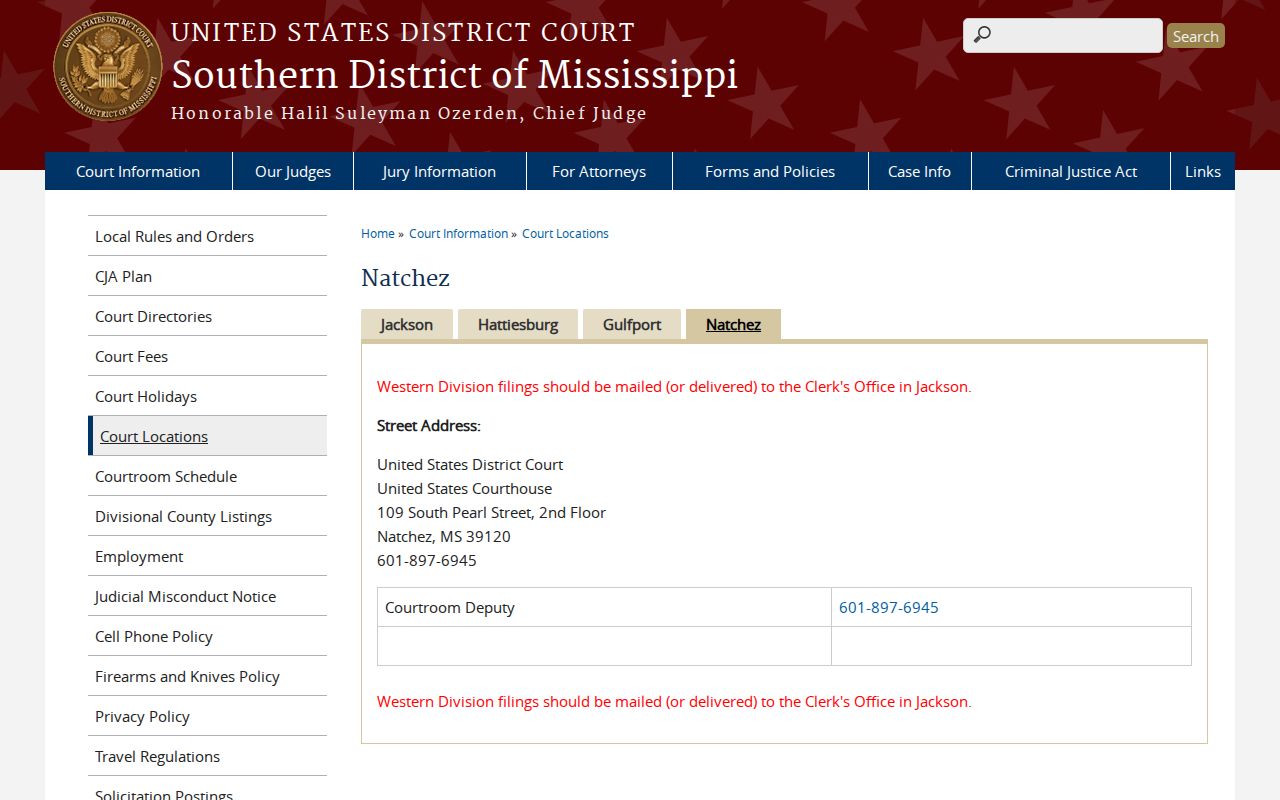
Three things follow from that split, and none of them replaces a call to the federal court or to a Claiborne County lawyer.
- The Natchez courthouse at 109 South Pearl Street is not a county warrant counter, and Western Division filings route to the Jackson clerk's office.
- Federal arrest process is served by the U.S. Marshals rather than by the Sheriff.
- A sealed federal complaint or indictment may not appear in any public docket system.